That's good question, Nikhil. Alternate breathing is basically a balancing pranayama. Let’s understand about it. We live in a world of changing balances, day and night, heat and cold, pain and pleasure, activity and rest and numerous of other fluctuating events which make up experience of life. Fluctuations pervade the whole existence, not only in our external world, but in our internal worlds of body, mind and spirit also. The flow of breath in each nostril is intimately connected with various dual functions such as right and left-brain hemisphere activity, sympathetic /para sympathetic nervous system dominance, action and relaxation and prana and manas shakti – all these fluctuations are reflected in the breath in each nostril. During the natural oscillations between the left and right nostrils, a balanced flow exists for a matter of only few minutes. But this period can be extended by altering the strength of the breath in the nostrils so that they remain equalized. And this is done by alternate nostril breathing. Using this pranayama, pranic channels are purified and proper flow of pranic energy throughout the body is enhanced. So, alternate breathing is basically more about the alternating inhalation and exhalation between the left and right nostrils, than what fingers are used for closing and opening the nostrils during the breathing practice.
So, through alternate nostril breathing, what we do is inhale breath from one nostril and exhale from other nostril the same breath and then switch sides (it is better to first exhale completely from left nostril and inhale through it and then alternate with right nostril for exhalation).
But the story does not stop here as regards the use of fingers in specific combination during breathing practice. So, Nikhil, you need to understand that such combination of use of fingers is basically called mudra. So, we need to have understanding of the depth of Mudra. In general term, mudra can be a combination of asana, pranayama and bandha or it may be a simple hand position. In the context of this question asked by you, hand mudra are important psycho-neural finger locks. Lets see the basic mechanism of how these mudra work. Every finger of hand relates to one of the five element of the nature. The thumb relates to fire, the index finger to air (matter in gaseous form), the middle finger to ether (space), the ring finger to earth (solid matter), and the little finger to water (liquids) and the palm of the hand relates to the mind.
When mudras are formed by using thumb (fire element) to lightly stimulate one or more of the other elements as you touch the tip, nail, knuckle or base of a finger. So, we can
- stabilize the influence of the linked element by joining the tip of corresponding finger,
- decrease the influence of the linked element by touching the back of the corresponding finger (nail or knuckle)
or
- increase the influence of the linked element by bring thumb to the base of the corresponding finger
Thus, each finger and thumb is said to hold a certain element quality and we can encourage energy to flow to or from certain areas of our being simply by changing the position of our hands.
During alternate breathing pranayama, we generally use Vishnu mudra wherein we curl our forefinger and middle finger in towards the palm of the hand and allow our thumb, ring and little finger to extend.
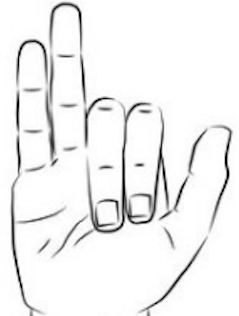
You may see that in this mudra, the impact of touching of thumb with the ring finger and little finger stabilize their elements which form Kapha (pronounced “kuffa”) which is based on earth and water. Kapha can be described as steady and stable. However, since these fingers are not touched during pranayama exercise, so their impact cannot be considered. However, you can understand that forefinger/index and middle fingers are bowed down. These fingers form the Vata which is a combination of air and ether which has links to change, mobility, and movement and if there is imbalance in the vata, this results in relative instability of our mind. And hence, this mudra is used during such breathing exercises. The success of such breathings obviously requires equilibrium of the mind. So, this much is the impact of using fingers for using for closing/opening nostrils.
Such combinations of fingers can also be seen in other breathing techniques like sectional breathing wherein if you want to increase sensitivity to breathing at subtle level of existence or take advantage of specific combinations in mudra, you may use fingers to close respective nostrils, like chinmudra, chinmaya mudra, brahma mudra, etc.
There are another justification of using such combination of fingers which is at the level of physical level. Some Yoga Texts are of the opinion that the strength of the ring and little fingers are equal to that of thumb and hence, this combination of Vishnu Mudra is formed. Whereas other hatha yoga texts opine that the middle two fingers have same strength to that of thumb so as to have equal closing pressure on both nostrils.
So, to have better balance to your nervous system and less stress response and activity over time, which is derived from the alternate nostril breathing, any combination of fingers on both sides will suffice. Even if some one has any kind of handicap on hands, that should not restrict him to get about full advantage from this pranayama, just because of inability to use such mudra.
But if you want to go in depth, you may or may not use Vishnu mudra, it is upto your own choice.
If you want to know justification on other mudras and their different combinations, you can go through my other answers at the following links: