Sectional Breathing
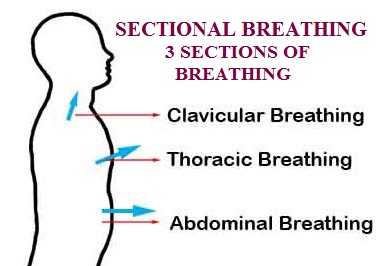
This breathing has 3 sections – abdominal, thoracic and clavicular and so it is called sectional breathing. First all these sections of breathings are performed, one by one individually, and at last, this is followed by all the breathings done simultaneously in the same order as done individually. This is done in any meditative posture keeping the neck and back straight and eyes closed like sukhasana, padmasana, ardhpadmasana, siddhasana or one can do this even sitting normally on chair or floor.
Abdominal Breathing
First abdominal breathing is done. Adopt chin mudra and place the hands on the knee. Inhale and exhale through the abdomen. You might have seen the breathing of a new born baby. The baby normally does abdominal breathing. With inhalation, abdomen bulges out. The abdomen returns inside with exhalation. Remember chest and shoulders will remain in their positions. Only abdomen keeps on expanding and contracting during this practice. Do this breathing for 8-10 times.
Thoracic Breathing
Then second breathing is Thoracic breathing or simply chest breathing.
- Continuing in the same sitting posture, adopt chinmay mudra and place the hands on the middle of the thigh.
- While inhaling, expand chest and breathe out through the chest as we normally do it but this time, do it with full awareness of chest muscles. Breathe deeply.
- Perform for 8-10 times.
Clavicular Breathing
The third one is clavicular breathing or simply shoulder breathing.
- Now, shoulders are raised up near ears, with inhalation and brought down to normal position with exhalation.
- Adopt Adi mudra and place the hands on the root of the thighs. Perform for same number of times i.e. 8-10 times.
Full Yogic Breathing (3 Sections Combined Breathing)
Now, when all the breathing is done simultaneously, it is called Yogic breathing. It helps in maximizing inhalation and exhalation and also rectifies the wrong breathing patterns. It is also helps in dealing with anger.
- With same sitting posture, adopt brahma mudra and keep the hands at naval region.
- Inhale slowly and deeply, allowing the abdomen to expand and buldge out (abdominal breathing).
- Now, inhale through chest and expand the chest (thoracic breathing) followed by rising up of shoulders and collar bones (clavicular breathing).
- Exhale in the same sequence, i.e. first by abdomen, chest and finally by shoulders. (Do not follow reverse sequence.)
- This is one round of Yogic breathing and may be done 5 to 10 times.
Brief Outline of Sectional Breathing
Abdominal Inhalation (1st Step) - Chest Inhalation (2nd Step) - Clavicular (Shoulder) Inhalation (3rd Step) - Abdominal Exhalation (4th Step) - Chest Exhalation (5th Step)- Clavicular Exhalation (6th Step) - [1 Round] - Continue with 1st Step.
Benefits of Sectional Breathing
- In this way, we have performed all sections of breathing, filling all areas of the lungs oxygenated. One study states that most of the respiratory illness are either in the lower lobes or upper lobes of the lungs, because they are not normally exercised and hence, remain unoxygenated. Thus, this sectional breathing keeps our lungs healthy.
- Such breathing with full awareness are helpful to combat stress, mental and physical fatigue instantly or when one is not having clarity of decision , take the help of sectional breathing.
If you have any other query, feel free to ask me here.